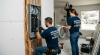
Where A Panel Can Legally Go, And Why Yours Might Be In The Wrong Place

Panel locations get chosen for convenience during construction and then live with the house for fifty years. A meaningful number of Wichita panels sit somewhere that would not be approved today.
Here are the rules, in the order they usually matter.
Rule one: working space in front
There must be a clear area in front of the panel. The depth requirement is measured from the face of the equipment outward, and for residential voltages it is three feet.
That space must be clear. Not clear when you move things. Clear.
This is the single most commonly violated requirement in residential electrical work, and the violation is almost always storage: shelving installed in front of a basement panel, a chest freezer pushed against it, coats hung on a rack in a utility room.
The reason is not tidiness. It is that someone may need to reach that panel quickly, possibly in the dark, possibly while something is going wrong.
Rule two: width and height of the working space
The clear space has a width, generally thirty inches or the width of the equipment, whichever is greater. It is centred on the equipment, not necessarily aligned with it.
Headroom is required, and it is more than most basements offer comfortably. A panel tucked under low ductwork frequently fails this.
Rule three: the panel cannot live in a clothes closet
This one surprises people. Overcurrent devices are not permitted in clothes closets, and the reasoning is stored combustible material immediately adjacent to equipment that can arc.
Panels in coat closets, linen closets and under-stair storage all appear in older Wichita housing, and the pre-war stock around College Hill and Riverside is where they turn up most. Some of them predate the prohibition. None of them would pass today.
Rule four: bathrooms are out
Panels are not permitted in dwelling unit bathrooms.
Rule five: it has to be readily accessible
Readily accessible has a specific meaning: reachable without removing obstacles, without a ladder, without going through a locked door you do not have the key to.
A panel behind a hinged bookcase is not readily accessible. A panel in a crawlspace you enter on your stomach is not. A panel in a locked utility room in a multi-unit building, where the tenant it serves cannot get in, is not.
Rule six: not over the steps
Equipment cannot be installed where the working space is over a stairway or step. There has to be somewhere to stand.
Rule seven: environment
Panels need to be in a dry location or in an enclosure rated for where they are. Standard indoor panels in damp basements, garages subject to moisture, or exterior walls without proper enclosure are all problems.
Wichita basements that take water seasonally are a recurring case. A panel that has been wet is a panel with a corrosion clock running.
If yours is in the wrong place
Existing installations are generally not required to be moved. Code applies going forward, and a panel installed lawfully in 1961 remains lawful where it sits.
Two things change that. A panel replacement usually triggers compliance with current location requirements, meaning a panel in a closet often cannot simply be swapped in place. And a remodel that affects the space can bring the requirement into play.
That is worth knowing before planning a panel upgrade in an older house, because relocation adds meaningful cost. Feeder conductors have to reach the new location, which sometimes means a longer service entrance run, and the old location has to be made good.
What relocation actually involves
The service entrance conductors from the meter have to reach the new panel position. If the meter stays put and the panel moves, that run gets longer and may need upsizing.
Alternatively the meter moves too, which brings Evergy into the schedule for a disconnect, a new socket location and a reconnect.
The grounding electrode conductor has to reach the new position, and the bonding to metal water and gas piping has to be re-established.
Every branch circuit has to reach the new panel, which usually means a junction arrangement at the old location with a feeder to the new one, or extending circuits individually.
Getting https://electricianwichita.com/ to price both options, in-place replacement where permitted versus relocation, before committing is worth doing, because the gap between them is sometimes small and sometimes very large depending on the layout.
Permits
Panel work in Wichita and unincorporated Sedgwick County is permitted through the Metro Area Building and Construction Department on the number above, and inspected against the 2023 National Electrical Code that Sedgwick County brought into force at the start of 2025. Working clearance is on the inspector's list every time.
The free thing to do this week
Go look at your panel and clear three feet in front of it.
That costs nothing, takes ten minutes, and addresses the most common electrical code violation in American houses.